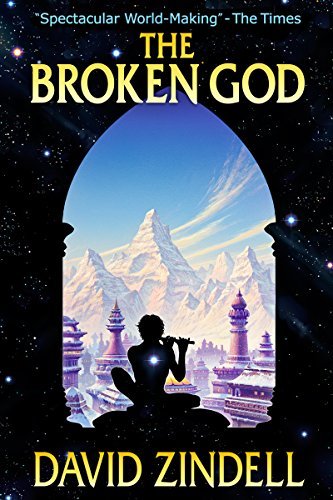
I imagine most authors would consider themselves ambitious. Nobody sets out to create a work of art that is purposefully mundane or uninspired – at least I don’t think they do.
What became clear 100 pages into The Broken God is that there is a very big difference between ambitious, and capital-a *Ambitious*. What David Zindell has done with his book is tackle as many grand and challenging ideas as possible: religion, Godhood, humanity’s purpose, philosophy, morality, memory, and even the nature of reality itself.
It’s hardly the first SF book to address some of these issues, but what sets it apart is the fearless approach it has to its themes. Philosophical and religious ideas are explored not via allegory or metaphor, but by characters directly addressing, debating and thinking very deeply about them. Characters talk, muse, learn new information, argue, change their minds, and grow. And everything is discussed all at once, like it’s all connected, the maths with the religion with the computers with the stars themselves. Somehow it all just *works*.
It’s a tremendously introspective book focused on what people think and why, and it’s not unusual to spend multiple pages as a character deconstructs eg. the symbology of a church, whereas something as “small” as piloting a spaceship happens off screen. As impossible as it might be to believe, these internal moments are just as important, interesting, and even thrilling as a climatic action scene or exciting plot twist.
Our protagonist, Danlo, is an odd one. His father was an incredibly famous star pilot that later became a god, a momentous act that has greatly influenced current events. His mother – who was also his father’s sister, oops – was a powerful and much respected scryer. Danlo himself was not raised by his parents or even among typical humans, but rather was adopted into an isolated tribe of Eskimo-esque Neanderthals, themselves descendants of humans who edited their DNA to become closer to primitive humanity. You keeping up so far?
Tragedy strikes Danlo’s tribe and he’s forced into civilization – the city of Neverness – where he discovers that life is much vaster than he ever could have imagined. We then watch Danlo grow up, learn new languages, philosophies, mathematics, religions, perspectives, and on and on. Danlo himself is a sponge, infinitely curious and able to absorb every detail – even the many contradictions – of the beliefs and ways of thinking he’s exposed to. It’s clear that Zindell made Danlo this way so he’d have an excuse to expose his readers to things he himself was interested in, and it was a very good choice.
Of the many differing perspectives in the book, the most important is a simple question: when viewing life, the universe, and everything, do you say “Yes” or “No”? In other words, do you accept both the beauty and ugliness of the world as-is, looking for new ways to experience and appreciate the fullness of being alive? Or do you reject a reality full of pain and suffering, and posit that we can – and should – do better? What would a god choose?
Danlo is firmly in the Yes camp, and we see just how he arrives at that belief and what he plans to do about it. In the No camp is his best friend Hanuman, who has a mind very similar to Danlo’s but with a much different background and context. Hanu has come out the other side with the exact opposite mindset, and their love and tragedy make up an enormous part of the book’s back half.
The phrase I kept thinking throughout my reading was “origin story”. That’s often used to describe superheroes, but I don’t mean it that way. It’s more like if you had the ability to go back in time and follow – and know the minds of – famous historical figures like Julius Caeser, Jesus, or Aristotle. Imagine how much more complete your understanding of history would be if you were there every step of the way.
The Broken God is full of these sort of grand origin stories. We see *exactly* what makes up the minds and motivations of Danlo, Hanuman, and a handful of supporting characters. More importantly, we see all the key moments leading to the creation of a sweeping religious movement, and the War in Heaven that is sure to follow. It’s fantastic stuff.
Obviously I also have complaints. Danlo himself is just a bit too much of a Gary Stu, intuitively mastering mind-bending concepts in way too short a time, particularly considering his tribal background. I also think the book is approximately 10% too much across the board: it has 10% too many pages, paragraphs are 10% too long, descriptions of things are 10% too detailed, etc. etc. Finally, I wish the supporting cast was stronger, more persistent; as is, they’re mostly set dressing for Danlo and Hanu to bounce off of.
Overall, I’d call The Broken God a triumph. It re-contextualizes the whole genre of scifi and shows a different way of crafting stories that fit within it. I get why the industry is not full of books like this, and to be honest I think I’ll need quite the break between my next Requiem for Homo Sapiens because it took a lot out of me. However, I do wish every book made me feel as deeply introspective and thoughtful as The Broken God did.
If you read anything I type, let it be this: it’s a very good book. I think everyone should read it. If you enjoy good prose, you’ll like it. If you have even the slightest interest in philosophy or religion, you’ll like it. If you want scifi that does something unique, smart, and can stand toe-to-toe with real literature, you’ll like it.