
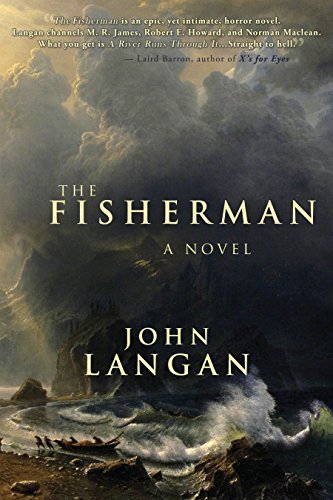
The Fisherman is a rambling horror story about a fishing enthusiast, Abraham – the first of many overt references – recounting the most difficult time of his life, and how fishing saved and then later nearly doomed him. Abe lays out nearly the entire plot in the first few chapters: his somewhat boring life will be damaged by a great tragedy, he’s going to encounter something very spooky related to fishing, and someone named Dan won’t have a good time.
Purely by accident, this book came to me at the perfect time of my life. It’s October, the spooky month. This year I got into fishing for the first time, stumbling into it by happenstance and then making it a core part of my life. Like the protagonist, I have discovered the positive, regulating effect fishing has on depression. I was as primed as possible, for better and worse.
It starts out great, with a sizable chunk focused on the joy of fishing and finding a renewed purpose after the rug is yanked out from under you. The relatable, very human parts of the book contrast nicely with the eldritch horror, which appears first on the edges before becoming the chief focus of the story. Abe is an easy guy to like, and you can see all kinds of cracks for where the horror can settle into.
But at about the 30% mark things change drastically. A side character in the book begins telling Abe a story, and it lasts for nearly the rest of the book. From a story standpoint, this tale is thankfully pretty good, on par with other gothic horror / New England Lovecraftian shorts you’d find in a horror collection.
The problem is that it’s ridiculously executed. First off, it’s far too long, accounting for half the book. It’s like pausing a movie to go read Wikipedia for an hour.
More unusually, the substory is told in second-person omniscient perspective, which is as jarring as you’d expect. Every story beat, every conversation, every emotion is perfectly recalled. At one point it hit me that the narrator was recounting a story told to him by his waiter, which was told to the waiter by a priest, which was told to the priest by a dementia patient, which was told to patient by her husband, which was told to him by his father-in-law, and yet still the details were crisp and beyond doubt.
My guess is that the author thought he was being clever: that by sneaking in a lore dump via a ghost story, you might not realize it was just a honking slab of exposition.
But it did feel like exposition. In fact, the structure overtly drew your attention to this fact. Around the sub-chapter XXVI I started just laughing at how unending the exposition dump actually was. I can’t imagine that’s the feeling the author was aiming for.
Once the substory is finished and it’s back to the main thread, things get good again, and it remains high through the end. The only problem is that the book occasionally tries to build tension by being coy about what’s going on, which I found irritating. He just spent 150+ pages outlining exactly what to expect, who exactly is he trying to fool?
Despite my complaining I’m still going with 3 stars because of I liked a lot of what I read. With better editing and different priorities this could be an all-time October classic. As it stands now, I’d recommend it, but cautiously so, and mostly to people who have an existing interest in Lovecraftian horror – or fishing.